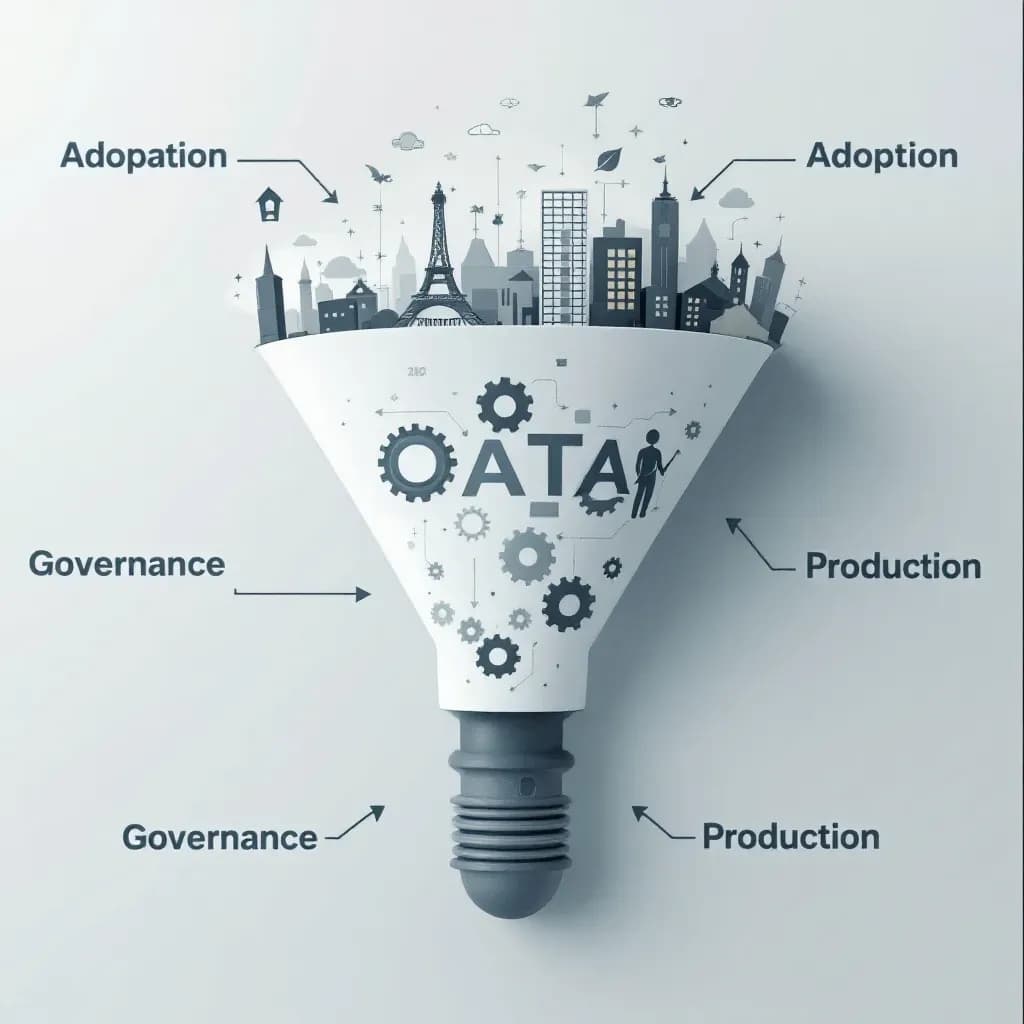
79% of enterprises adopted AI agents; only 51% in production
# 79% of Enterprises Adopted AI Agents; Only 51% Run Them in Production
Enterprise AI agent adoption has plateaued at a critical bottleneck in mid-2026: while 79% of senior executives report their organizations have adopted AI agents in some form, only 51% actually run them in production, leaving a 28-point gap between experimentation and operational deployment.
The disparity, documented in TechStoriess' Agentic AI Implementation Guide 2026, reflects what industry analysts now call the defining challenge of 2026. The remaining 28% of adopters remain trapped in pilots, sandboxes, and single-team trials—unable to scale beyond proof-of-concept despite working models.
The Root Cause: Governance, Not Technology
The blockage is not a problem of AI capability. According to the research, the pilot-to-production gap stems from scoping and governance issues, not model quality. Enterprises struggle with role clarity, approval workflows, data integration, compliance frameworks, and cost controls—organizational friction points that no amount of algorithmic improvement can solve.
FwdSlash's 2026 AI agent statistics reinforce this finding: a separate pilot-to-production gap calculation shows 62% of organizations experimenting with agents versus only 23% with scaled deployments, a 39-point spread. Deloitte's late-2025 research, cited by Zywave, breaks the maturity ladder into discrete stages: 30% exploring, 38% piloting, 14% deployment-ready, and 11% in full production.
Enterprise Deployment Costs Drive Selectivity
Financial barriers also constrain production scaling. Single-workflow deployments range from $10,000 to $50,000, while enterprise-wide agent implementations demand $500,000 or more. This cost structure forces organizations to prioritize high-ROI use cases and delays broad rollout.
The 79% adoption figure—consistently reported across FwdSlash, Laxis' 2026 State of AI Sales Agents, and Nevermined's market analysis—represents a plateau. Growth in adoption has flattened; the competition among AI agent vendors now centers on helping the trapped 28% cross the finish line into production.
What Separates Winners From the Rest
Organizations closing the gap fastest are those that standardize governance templates, automate approval workflows, and establish clear cost-tracking mechanisms before agents touch production systems. The research suggests that by late 2026, the strategic advantage will belong not to companies with better models, but to those with better operational scaffolding.
As the market matures, the narrative is shifting from "Can we build agentic AI?" to "Can we operationalize it at scale?" The answer, for 28% of enterprises, remains blocked.